|
||
|
|
||
|
||
| Site Design by Cassidy Web Creations July 18, 2026 |


|
||
|
|
||
|
||
| Site Design by Cassidy Web Creations July 18, 2026 |
Surreal Landscapes, Fairy Chimneys, and Hidden Underground Cities
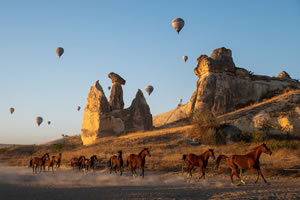
At sunrise, the whimsical landscape of Cappadocia unfolds as hot-air balloons ascend silently, their vibrant colors a stark, surreal contrast to the pale stone below. The balloons drift gracefully over spectacular valleys honeycombed with cave dwellings, ancient churches and monasteries, and underground cities carved by early civilizations.
Millions of years ago, volcanic eruptions rained ash across the Central Anatolia region. The ash hardened into tuff, a soft, porous rock that was covered by a layer of harder basalt. Millennia passed, and the slow process of erosion began. Wind and water slowly wore away the softer tuff to form pillars of rock. The basalt on top eroded more slowly and formed a mushroom-shaped cap over each pillar, protecting it from further erosion, creating a fairy chimney or hoodoo.
From 1650 BC to 1178, Anatolia was inhabited by the Hittites, who discovered that the soft tuff of the fairy chimneys could be excavated and carved into dwellings. After the collapse of the Hittite Empire, the Phrygians from the Balkan Peninsula moved into the area. They continued to carve extensive networks of tunnels and chambers into the soft rock, creating massive underground cities that served as shelters and refuge from the armies of the Roman Empire and later onslaughts from Islamic armies. The largest subterranean city Özkonak, housed sixty thousand inhabitants on seventeen levels, and remains largely unexplored. Cities are still being uncovered, and the Cappadocia region has yet to reveal all its secrets.